ClojuTRE 2016 演講筆記
趁著假日來趕一下進度,於是把我看過的 ClojuTRE 2016 心得/筆記紀錄在這邊。
嗯......其實 ClojuTRE 2016 每一場演講我都看完了.....
當然,我並不是每一場都聽的懂,於是這筆記只能僅供參考,請勿盡信 orz...
有些演講真的很難畫重點,還是挑自己有興趣的看吧!!
Using Clojure to provide computerized psychotherapy
講者投影片: 下載連結
這場演講在講 Clojure 用於心理治療 (psychotherapy) 上,一開始講者提出了問題:

對於這些問題,我們可以有一些解法:

而更多的問題,則是沒有足夠的人手在心裡治療上,因此講者提到了可以透過電腦來協助,點子來自於 treatment manuals

而 網路認知行為治療 (iCBT, internet-based Cognitive behavior therapy) 則大部分提供了如上面的那樣的自我治療(sel-help)資訊,這種方式減少了一些問題,比如治療師(therapist)和病患之間的距離
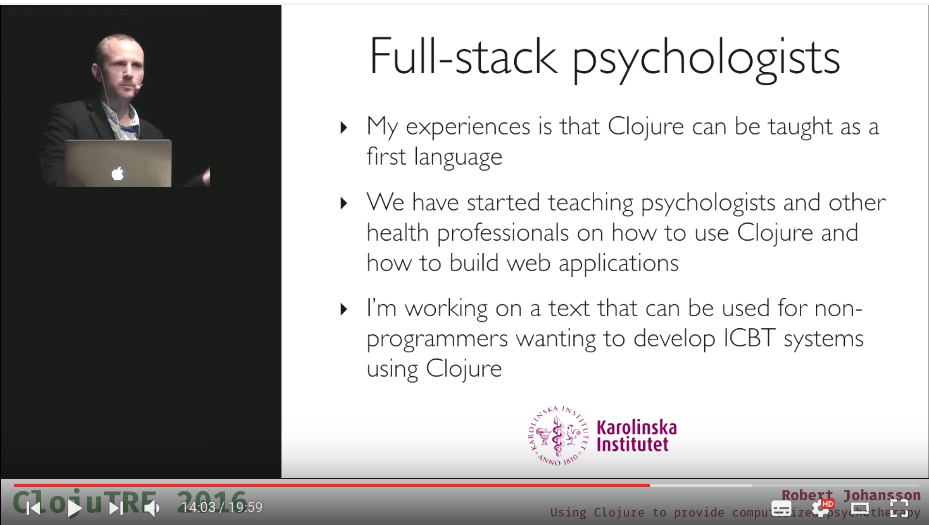
然後後面講者繼續講了一些問題,解法一是用 Clojure 寫了些網頁程式....(嗯,看影片吧) ,而這網頁程式透過 Luminus framework 製作,值得一提的是講者第一個學的程式語言就是 Clojure。
The Universe As A Value
投影片: 下載連結
這場演講第一次聽的時候我傻眼了,於是就再聽了第二次。
講者一開始先稍微講了些關於宇宙 (Universe) 的事情,然後導向愛因斯坦的相對論,我們可以假設有一個觀察者如下
(def observer (atom {:universe u :time t}))
而愛因斯坦說過,時間和觀察者是相對的 (time is relative to observer),兩個不同的觀察者會看到不同的宇宙 (Universe),也就是說,有許多不同的宇宙(Universe)存在。
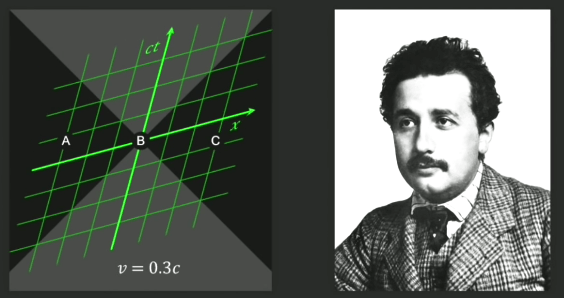
我們可以定義 𝕌 這個符號為所有可能可以觀察到的宇宙空間(𝕌 is the set of all possible observable universes),因此,我們就可以定義 Clojure 程式用來選擇下一個 Universe。
(defn next-u
  "Given an observed universe u, return a possible 'next' universe."
  [u t]
  (rand-nth (filter #(consistent? % u t) 𝕌)))
而下一個程式碼,則是讓一個觀察者 (observer) 切換到另外一組 Universe 去
(defn switch-universe!
  "Put the given observer in another universe"
  [observer]
  (swap!
   (fn [{:keys [universe time]}]
     {:universe (next-u universe time)
      :time (inc time)})
   observer))
而我們可以這樣執行我們的觀察者:
(defn run-observer
  "Run the observer, giving them the impression of passing time"
  [observer]
  (dorun (iterate switch-universe! observer)))
接下來接到了 Pump-probe technique ,嗯...我不知道他在講啥 (摀臉)....所以只好秀一下他接下來的投影片:
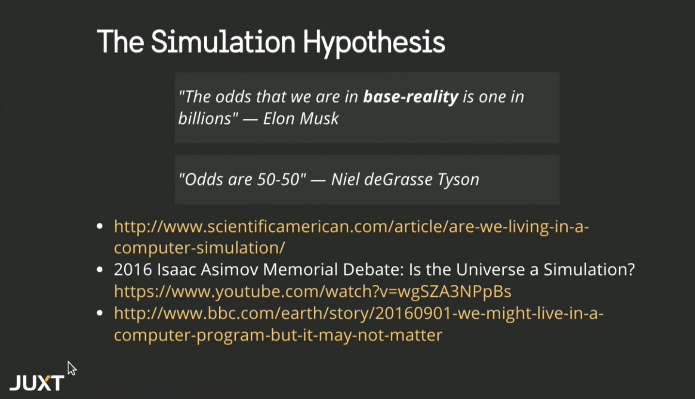
接下來話鋒一轉,突然變成說...在 ClojureScript 中,無論是 Om 或是 Reagent, 我們都有一個地方定義 app state (universe)
;; The app 'universe'
(def app-state
  (atom
   {:drawer {:items [{:name "ear-plugs"}]}
    shopping
    {:items
     [{:name "Coffee" :quantity 2}
      {:name "Milk" :quantity 2}
      {:name "Bird seed" :quantity :lots}]}}))
接著我們就可以用 deref 去查看我們的 Universe (app state)
(deref app-state)

;; or

@app-state
而在這種狀況下,我們滿足了以下兩種規範:
Consistency
In the render phase, the value we render is constant
Concurrency
We can take our time, nobody is waiting for us!
這種 app-state 的形式和物件導向 (Object Orientation) 是不同的,我們知道物件導向是這樣的:
Object Orientation: Lots of changing state, scatered around.
講者舉 https://juxt.pro/ 為例,這個網站有很多 state 要去處理,因此我們可以做一個 record 去弄這些 state
(defrecord AppState [data-sources]
  clojure.lang.IDeref
  (deref [this]
    (skup/refresh! this)
    ;; Return the 'universe as a value'
    ))
;; Skippy McSkipface: https://github.com/juxt/skip
接下來我們就可以對這些 state 進行 derefernece 的動作
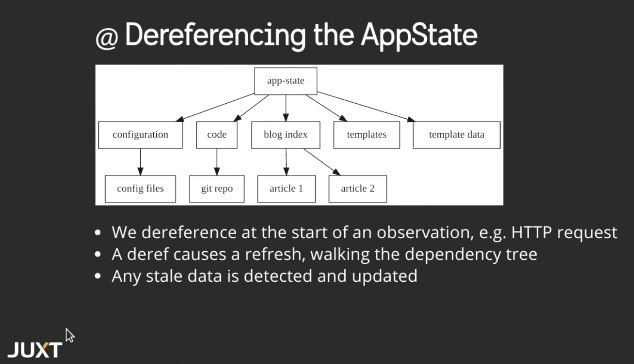
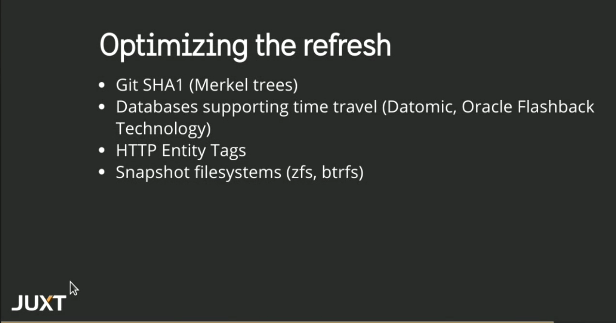
那要怎樣提昇 referesh 的效能呢?我們可以透過這些支援 time-travel 的工具來進行:
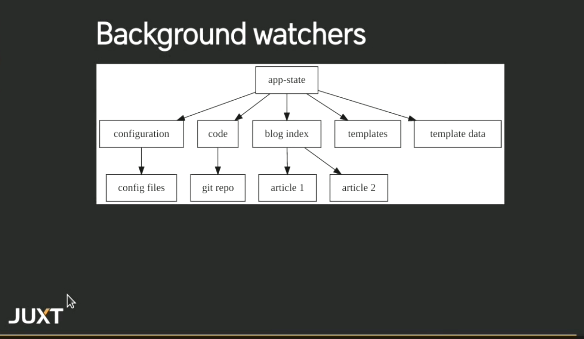
而在開發環境,則可以透過 background watchers 來對資料進行更新的動作
而這樣做,講者提出了一個結果:
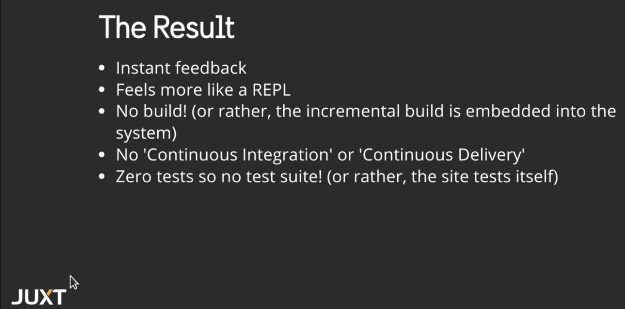
嗯...我必須承認我聽了兩次還是聽不太懂 = =
最後講者對比了一下 C 和 Lisp:
It seems to me that there have been two really clean, consistent models of programming so far: the C model and the Lisp model.
-- Paul Graham
"You're not constructing it like making a tone of source code and compiling it periodically, you're constructing it the way you construct a city: build some of it, it's running all the time, so it's kind of like a live programming language."
-- Dick Gabriel On Lisp, Software Engineering Radio Episode 84
Native mobile apps with ClojureScript
終於有看到一場在講 react-native 作用於 ClojureScript 上的演講!! 這之前我有稍微玩過,但沒認真寫這樣的程式。
關於 ClojureScript 作用在 react-native 上的資料,可以到 http://cljsrn.org/ 去找,或是 Clojurians 的 Slack #cljsrn 頻道。
這場演講先從 react-native 開始介紹,說明它和 Cordova/HTML5 的不同:
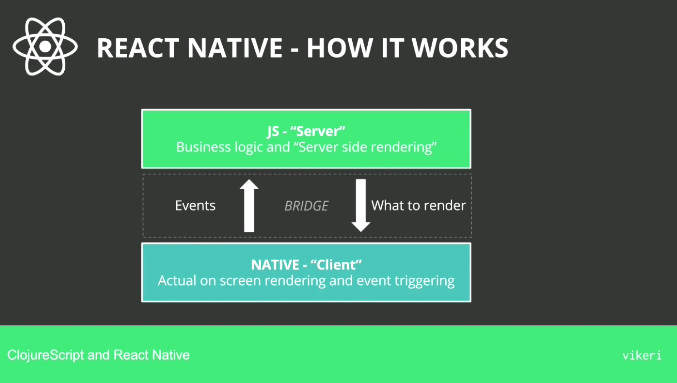
接下來則是以開發者的觀點來看 react-native,一個基本的 react-native 程式長這樣:
import React, { Component } from 'react';
import { Text, View } from 'react-native';

class WhyReactNativeIsSoGreat extends Component {
    render() {
        return (
            <View>
              <Text>
                If you like React on the web, yoou'll like React Native.
              </Text>
              <Text>
                You just use native components like 'View' and 'Text',
                instead of web components like 'div' and 'span'.
              </Text>
            </View>
        );
    }
}
而 ClojureScript 的相對應改寫則是:
(ns rn-example.core
  (:require [reagent.core :as r]))

(def react-native
  (js/require
   "react-native/Libraries/react-native/react-native.js"))

(def view (r/adapt-react-class (.-View react-native)))
(def text (r/adapt-react-class (.-Text react-native)))

(defn why-react-native-is-so-great []
  [view
   [text "If you like React on the web, you'll like React Nateive"]
   [text "You just use native components like 'View' and 'Text'
instead of web components like 'div' and 'span'."]])
由上面範例可以看到,除了一開始載入一些 javascript 函式庫需要比較骯髒的手段外,剩下的就很純粹是 Clojure 的資料結構的處理。
而在 ClojureScript 上面,目前有兩個 build tools 針對 ClojureScript 在 react-native 上的:
講者是這樣評論這兩套工具的:
boot-react-native
Uses boot, works closer to the RN packager but is slower and inferior out of the box experience (persornal experience)
re-natal
Uses leinigen, runtime errors are not traceable, templates for re-frame, om.next and rum
而最常用的前端框架則是基於 reagent 的 re-frame 。
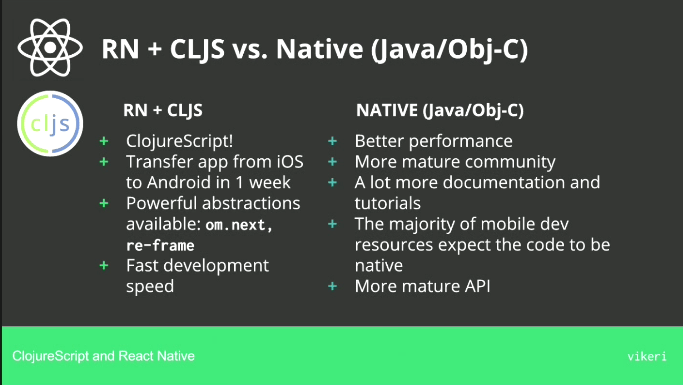
測試方面,則是需要透過 react-native-mock 去對 ract-native 組件進行測試,圖片和函式庫則是透過 mockery 來進行測試。
至於效能的比較,就直接看投影片吧:
Isomorphic web apps with Rum
本場次為 rum 這個 ClojureScript 對於 React.js 的封裝的作者的演講,講者 tonsky 同時也是許多知名 Clojure/Script 函式庫專案的維護者。
tonsky 一開始介紹幾種不同在 ClojureScript 上對於 React.js 的封裝函式庫,然後介紹自己設計 rum 的幾個動機,其中一個是更好的與 datascript 或是其他資料儲存函式庫相容。
所以基本的 rum 程式長怎樣呢?
(rum/defc label [text class]
  [:div.lbl {:class class} text])

(rum/mount (label "Hello" "header")
           js/document.body)
包含 state 的複雜點的範例則是:
(def mixin
  {:will-mount
   (fn [state]
     (assoc state :key (atom nil)))})

(rum/defc label < mixin [text class]
  ([:div.label {:class class} text]))
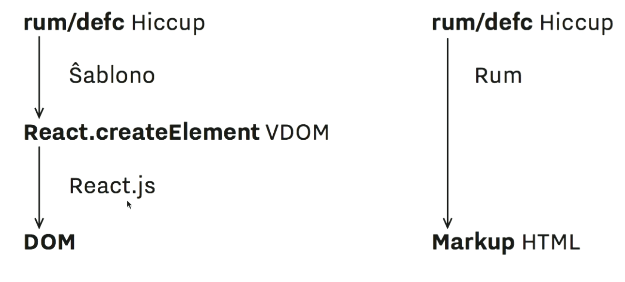
而 rum 也支援 serveri-side 渲染 (Om.Next 也支援囉~),運作的流程是這樣:
那用 rum 有什麼好處呢?講者提出了以下幾點:
- Complex single-page apps with fine control
- Custom/mixed state models
- Server-side rendering and templating
而用 rum 的壞處則是:
- Doesn't teach you how to write apps
The Story of Sir Owl Lisp
Owl Lisp 是一個純函數式的 Scheme 實現,講者為 owl-lisp 作者,此一專案作為寵物專案 (pet project, 閒暇時做的好玩專案或是殺時間用) 從 2011 年開始自今。
這場演講前面基本上在講古,包含了一些圖靈機、lambda 演算法以及 LISP 語言的故事,後面開始介紹 owl-lisp ,這是一個依照 R7RS 標準的 Scheme 語言。
Doing data science with Clojure: the good, the bad, the ugly
投影片連結: 線上看
Easy things should be easy and hard things should be possible.
-- L. Wall
老實說我聽不太懂講者在講什麼..... Orz...
不過講者提到一個他寫的函式庫:
然後...我還是聽不懂,所以只好把他 quote 的名言秀一下了 orz...
This is possibly Clojure's most important property: the syntax expresses the code's semantic layers. An experienced reader of Clojure can skip over most of the code and have a lossless understanding of its highlevel intent.
-- Z.Tellman, Elements of Clojure
接下來講者稍微提到了 clojure.spec 這個預計要在 Clojure 1.9 加入的函式庫,可以減少查找問題的時間,以及 gorilla-repl 這種類似 ipython notebook 的工具。
在後面,講者終於講到前面他說的函式庫 huri, 你可以透過他在 gorilla-repl 上畫圖。
Interactive Clojure code snippets in any web page with KLIPSE
投影片連結: 線上看
klipse 是一個完全運作在瀏覽器上的 cljs REPL,可以動態的驗證 ClojureScript 的運作,該作者同時也寫了不少關於 ClojureScript 運作的文章。
本次演講除了說到 ClojoureScript 的部份,也提到 klipse 可以執行 ruby, python 程式碼,我猜他大概有實現一個簡單的解釋器才對,還沒去看這部份的程式碼。
Distributed transducers
投影片連結: 點我下載
本篇講述講者實作分佈式版的 fold 函式,並透過 AWS lambda 來加速運作。
講者提供了一個查找類似詞的函式來描述整個要解決問題的狀況:
(defn similar-words-1 [word words min-distance]
  (->> words
       (map (partial levensthein-distance word))
       (filter (fn [[d _]] (<= d min-distance)))
       (reduce group-by-distance {})))

(similar-words-1 "word" ["sword" "lord" "card" "cat"] 2)
;; => {1 #{"sword" "lord"}, 2 #{"card"}}
當然我們可以把這樣的程式改用 transducer 改寫,來提昇程式的效能
(defn similar-words-2 [word words min-distance]
  (transduce (comp (map (partial levensthein-distance word))
                (filter (fn [[d _]] (<= d min-distance))))
             group-by-distance
             words))
但是這樣的程式無法並行運算,因此我們再用 fold 來改寫
(defn similar-words-3 [word words min-distance]
  (r/fold (partial merge-with concat)
          group-by-distance
          (r/folder words
                    (comp (map (partial levensthein-distance word))
                       (filter (fn [[d _]] (<= d min-distance)))))))
不過有一個問題,fold 會同時執行兩個函式,一個用來執行 reduce,稱為 reducing function ,另外一個則是用來合併結果,稱為 combining function ,而 reducing function 會並行的執行。(參考資料)
fold uses two functions: a "reducing" function, which it calls as a regular reduce across segments of the input collection, and a "combining" function, which combines the results of these reductions.
因此我們可以再把這個程式改寫
(defn similar-words-4 [word words min-distance]
  (r/fold (partial merge-with concat)
          ((comp (map (partial levensthein-distance word))
              (filter (fn [[d _]] (<= d min-distance)))) group-by-distance)
          words))
這樣改寫後,效果好多了,但是還有最後一個問題: 並行化的 fold 只能運作在 non-lazy sequence 上,於是再加一些手腳。
(defn similar-words-5 [word words min-distance]
  (r/fold (partial merge-with concat)
          ((comp (map (partial levensthein-distance word))
              (filter (fn [[d _]] (<= d min-distance)))) group-by-distance)
          (vec words)))
跑出來的結果如下,在講者的 HP zBook 筆電 (i7 雙核)上執行的結果是這樣的
- 一般版本: ~175 s
- Transducer: ~170 s
- Parallel fold: ~108 s
做完這些測試後,講者想到了,是否分佈式的 fold 可以提供更好的效能?
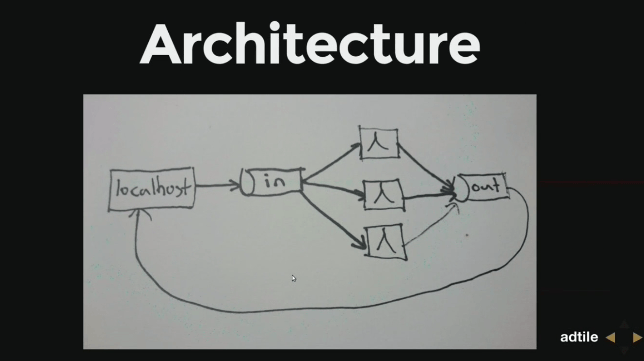
講者選用了 AWS Lambda 以及 Amazon SQS 來進行這個測試,整體的架構是這個樣子的:
接下來你要在你的 project.clj 加入以下這些設定
:plugins [[lein-clj-lambda "0.5.1"]]
:lambda {"demo" [{:handler "distributed-transducers-poc.LambdaFn"
                  :memory-size 1536
                  :timeout 300
                  :function-name "distributed-transducers-poc"
                  :region "eu-west-1"
                  :policy-statements [{:Effect "Allow"
                                       :Action ["sqs:*"]
                                       :Resource ["arn:aws:sqs:eu-west-1:*"]}]
                  :s3 {:bucket "mhjort-distributed-transducers-poc"
                       :object-key "lambda.jar"}}]}
然後使用下面命令進行 deploy
lein lambda install demo
講者給出了範例,示範用 fold 以及 dfold 執行程式的狀況
(ns distributed-transducers-poc.demo
  (:require [distributed-transducers-ppc.rc :refer [dfold]]
            [clojure.core.reducers :as r]))

(r/fold + ((map inc) +) (range 100000))

(dfold + ((map inc) +) (range 100000) 2) ; <= 2 is how many instance you run
那... 哪些資料會被送到 SQS 呢?
- 要被執行的東西 (Chunk of items to be processed)
- Reduct function
而在最後,使用分佈式 fold 的程式會變成這樣
(defn similar-words-6 [word words min-distance]
    (dfold (partial merge-with concat)
           ((comp (map (partial levensthein-distance word))
               (filter (fn [[d _]] (<= d min-distance)))) group-by-distance)
           (vec words)
           10))
而最後整體測試結果則是:
- 筆電 (一般): ~175 s
- 筆電 (transducer): ~170 s
- 筆電 (parallel fold): ~108 s
- AWS Lambda (10 nodes, cost 0.01 $): ~40 s
- AWS Lambda (20 nodes, cost 0.02 $): ~28 s
Introduction to clojure.spec - Arne Brasseur
講者為 LambdaIsland 的維護者,該網站提供了一系列的 Clojure/ClojureScript 教學,若有興趣的話可以付費訂閱。
clojure.spec 是 Clojure 預計在 1.9 版加入的新功能,對於 Clojure 這種動態型別語言而言,雖然容易開發,但是一旦你傳送給函式的型別不對,就很可能造成除錯不易。
在 clojure.spec 出現之前,比較有名的型別檢查是 core.typed 以及 schema ,而 clojure.spec 將會成為 buildin 在 Clojure 的一部分函式。
clojure.spec 的加入並不會導致程式執行變慢,用到他的時間只有在開發時使用 REPL 以及編譯的時候,所以到底要怎樣用呢?
如果你是 leinigen 的用戶,更改你的 project.clj 成如下
(defperoject myproject "0.1.0-SNAPAHOT"
  :dependencies [[org.clojure/clojure "1.9.0-alpha13"]])
boot 的用戶則是在你的 build.boot 加入
(set-env!
 :dependencies '[[org.clojure/clojure "1.9.0-alpha13"]])
於是讓我們開始使用 clojure.spec 吧! 講者假設現在有一個機器人主廚 (Robot Chef) 正在弄一份菜單 (recipes),而這份菜單內容是這樣的:
(def tomato-sauce-recipe
  {:robochef/ingredients [250 :g "peeled tomatoes"
                          3 :clove "garlic"
                          5 :g "pepper"]
   :robochef/steps ["heat a pan"
                    "throw everything in"
                    "stir"]})
像這種透過 / (slash) 組成的 keyword (關鍵字),我們稱呼為 namespace keyword
:grettings/kittos
;; => :grettings/kittos
為何要用 namespace keyword 呢?一個原因是可以避免到名稱衝突,所以我們可以把所有的 keyword 合併在同一個 map 中
{:http/method :get
 :robochef/method :stir}
實際上在 Clojure 中,變數也是包含在 namespace 中的
(ns robochef.core)

(def ingredents {,,,})

:robochef.core/ingredients
;; => :robochef.core/ingredients

::ingredients
;; => :robochef.core/ingredients
也因此,在一個 map 中使用 namespace 作為 prefix 是很常見的
{:robochef/recipe-name "..."
 :robochef/ingredients [,,,]
 :robochef/steps [,,,]
 :robochef/cooking-time 30}
而在 Clojure 1.9 中,將會有新的語法可以把上面的東西變成這樣
(def recipe #:robochef{:recipes-name ""
                       :ingredients [,,,]
                       :steps [,,,]
                       :cooking-time 30})

(let [{:robochef/keys [steps serves]} recipe]
  (doseq [s steps]
    ,,,))
在了解這些前置訊息後,我們終於可以來到 clojure.spec 了,首先我們把 clojure.spec 的命名空間(namespace) 指定為 s ,接下來我們加入以下這些 spec,這會將這些 spec 加入到全域去 (global registry)
(ns robochef.core
  (:require [clojure.spec :as s]))

;; keep in mind ::recipe == :robochef.core/recipe

(s/def ::recipe (s/keys :req [::ingredients]
                        :opt [::steps]))

(s/def ::ingredients (s/* (s/cat :amount number?
                                 :unit keyword?
                                 :name string?)))

(s/def ::steps ,,,)
好了後,我們就可以這樣去驗證,符合 spec 的狀況是這樣的
(s/valid? ::robochef/ingredients [5 :g "tea"])
;; => true

(s/conform :robochef/ingredients [5 :g "tea"])
;; [{:amount 5, :unit :g, :name "tea"}]
那錯誤的情況呢? 我們可以透過 clojure.spec/explain 來幫我們找出狀況
(s/valid? ::robochef/ingredients ["10" :g "tea"])
;; => false

(s/conform :robochef/ingredients ["10" :g "tea"])
;; => :clojure.spec/invalid

(s/explain :robochef/ingredients ["10" :g "tea"])
;; In: [0] val: "10" fails spec:
;;   :robochef/ingredients at: [:amount] predicate: number?
我們也可以用 generator 去產生符合數量並可以通過測試的結果
(s/exercise :robochef/ingredients 2)
;; ([() []]
;;  [(0 :Hi "0") [{:amount 0, :unit :Hi, :name "0"}]])
更多的內容我還在消化中,就請看影片吧 ~
後面演講則稍微提到一下 test.check 這個測試用的函式庫。
Clojure of Things
講者提及自己的經驗,如何用 Clojure 在目前火紅的 IoT (Internet of things) 上,並使用了 pibrella 這個 Raspberry Pi 的擴充板進行展示,透過 Clojure REPL 動態的控制 pibrella 的 I/O。
作者使用的函式庫目前我沒在網路上找到,但是我猜他是用 pi4j 來作為 Clojure 控制 Raspberry pi 的函式庫。
The Next Five Years of ClojureScript
這場是目前 ClojureScript 主要維護者 David Nolen 環顧了過去幾年 ClojureScript 開始開發的狀況,以及未來的情況。
在這場演講後半段也提及到如何參與 ClojureScript 推廣/開發等議題,也有人提問 David Nolen 對於 WebAssembly 的看法等等。
這場演講我覺的蠻不錯的,很喜歡這種有講故事風格的演講。